

What are the primary manufacturing processes for titanium tubes?
Oct 17, 2025
Leave a message
As a critical industrial material, the manufacturing process of titanium tubes directly impacts product performance and application scope. Current mainstream methods are categorized into seamless titanium tubes and welded titanium tubes, with a range of specialized forming technologies also emerging. Below are the core characteristics and technical analyses of each process.
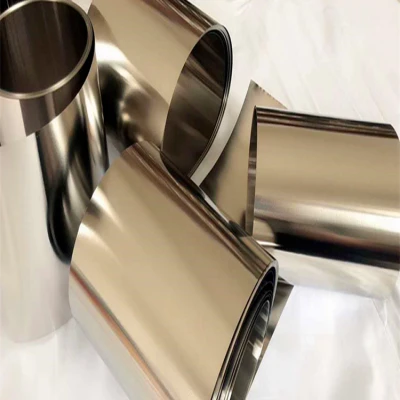
I. Primary Manufacturing Processes for Seamless Titanium Tubes
1. Extrusion-Rolling Combined Process
Process Steps: Billet preparation → Piercing → Sleeve extrusion → Surface treatment → Blank rolling → Multi-pass cold rolling → Intermediate annealing → Final inspection.
Process Advantages: Capable of producing ultra-long precision titanium tubes as small as 2mm in diameter, with wall thickness tolerances controlled within ±0.05mm. Suitable for demanding conditions such as high pressure and high temperature.
2. Oblique Rolling Piercing Process
Suitable for manufacturing large-diameter thick-walled titanium tubes. Solid billets are transformed into hollow tube blanks via an oblique rolling mill, followed by cold rolling for finishing to achieve high dimensional consistency.
3. Spinning Forming Process
Core Advantages: Enables production of ultra-large-diameter thin-walled titanium tubes with 20%–50% higher material utilization than traditional methods. Finished inner wall surface roughness Ra < 0.8μm.
Process Limitations: Demands high roundness and wall thickness uniformity in tube blanks; risks uneven deformation during forming.
II. Welded Titanium Tube Manufacturing Processes
1. Longitudinal Seam Welding Process
Typical Flow: Uncoiling titanium strip → Automatic TIG welding for longitudinal seam → In-line NDT → Sizing and straightening.
Application Features: Suitable for batch production of thin-walled titanium tubes, offering high production efficiency and approximately 30% lower overall cost compared to seamless tubes.
2. Spiral Welded Tube Process
Utilizes spiral forming equipment to continuously roll and weld titanium strip. The weld strength can reach over 95% of the base material. Primarily used for large-diameter transport pipelines in chemical and marine engineering.
III. Special Forming and Advanced Processes
1. 3D Printing Additive Manufacturing
Utilizing Electron Beam Melting (EBM) or Selective Laser Melting (SLM) technology to directly fabricate titanium tubes with complex internal structures, such as topologically optimized heat dissipation conduits. Products exhibit high density with porosity controllable below 0.5%.
2. Composite Processing Technology
Combining spin forming with mechanical expansion techniques to produce non-standard, irregular titanium tubes. Precisely controlling expansion ratios between 1.2%–1.5% effectively prevents micro-cracks in the tube body.
The above process routes represent the mainstream technologies for current titanium tube manufacturing. Enterprises can select the most suitable forming solution based on tube specifications, performance requirements, and cost budgets. With technological advancements, additive manufacturing and hybrid processing are progressively expanding the application boundaries of titanium tubes in aerospace, medical implants, and high-end heat exchangers.
Mob: +86-13772502581
Email: judesteel@juqing.hk
Send Inquiry