

Manufacturing Process of Double-Sided Submerged Arc Welded Straight Seam Steel Pipes
Feb 06, 2026
Leave a message
Double-sided submerged arc-welded straight-seam steel pipes are widely used in major projects such as oil and gas pipelines, the South-to-North Water Diversion Project, subway projects, and the West-to-East Gas Pipeline Project. But do you know its manufacturing process? Plate Inspection: After entering the production line, the steel plates used to manufacture large-diameter straight seam submerged arc welded steel pipes undergo ultrasonic testing of the entire plate.
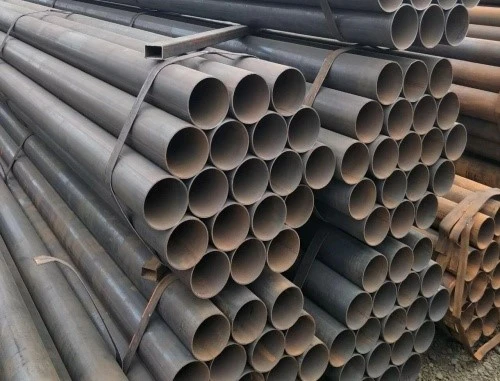
Edge Milling: The steel plates are milled on both sides using a milling machine to achieve the required plate width, edge parallelism, and bevel shape.
Edge Pre-bending: The plate edges are pre-bent using a pre-bending machine to achieve the required curvature.
Forming: The steel plate is first pressed into a U-shape in a forming mold, then into an O-shape, before internal and external submerged arc welding.
Pre-welding: The formed straight seam welded steel pipes are joined together and continuously welded using gas shielded welding (MAG).
Internal Welding: Longitudinal multi-wire submerged arc welding is used to weld the inside of the straight seam steel pipe.
External Welding: Longitudinal multi-wire submerged arc welding is used to weld on the outer side of the straight seam submerged arc-welded steel pipe.
Ultrasonic Inspection I: Ultrasonic testing is performed on the inner and outer welds of the straight seam welded steel pipe, as well as the base material on both sides of the weld.
X-ray Inspection I: X-ray industrial television inspection is performed on the inner and outer welds, using an image processing system to ensure the sensitivity of the flaw detection.
Diameter Expansion: The entire length of the straight seam submerged arc-welded steel pipe is expanded to improve the dimensional accuracy of the steel pipe and to improve the distribution of internal stress.
Hydraulic Pressure Testing: Each expanded steel pipe is inspected on a hydraulic pressure testing machine to ensure that the steel pipe meets the standards. The machine has automatic recording and storage functions to meet the required test pressure.
Beveling: After inspection, the steel pipes are processed to achieve the required bevel dimensions.
Ultrasonic Testing II: Each pipe is subjected to ultrasonic testing again to check for potential defects in straight seam welded steel pipes after expansion and hydrostatic testing.
X-ray Inspection II: Steel pipes after expansion and hydrostatic testing undergo industrial television radiographic inspection and end weld radiography.
Magnetic Particle Inspection of Pipe Ends: This inspection is performed to detect pipe end defects.
Corrosion Protection and Coating: Qualified straight seam welded steel pipes are coated with anti-corrosion materials according to user requirements.
In addition to the above testing items, according to API standards and other relevant standards, as well as some user-specific requirements, non-destructive testing and other inspections are also required for steel plates and pipes. These include random sampling of the physical and chemical properties of incoming raw materials and 100% visual inspection of steel plates.
Email: judesteel@juqing.hk
Send Inquiry