

Aluminum Alloy Round Bar Extrusion Process
Aug 14, 2025
Leave a message
Aluminum and its alloys play a key role in numerous fields due to their outstanding properties, including low density, high strength, excellent electrical conductivity, superior corrosion resistance, and excellent formability. Furthermore, they maintain their properties at low temperatures, exhibit no magnetization, exhibit no sparking upon impact, are sound-absorbing, and are resistant to nuclear radiation. These advantages offer the aluminum industry unlimited growth potential.
Aluminum and aluminum alloy profiles are widely used in construction, transportation, electronics, aerospace, and other fields. In recent years, driven by the demand for smaller and lighter automotive air conditioning systems, the proportion of aluminum extruded products, such as heat exchanger tubes and hollow profiles, has rapidly increased. Extruding aluminum alloy round bars is a complex process that requires precise control of each step and process parameters. The following is a detailed introduction:
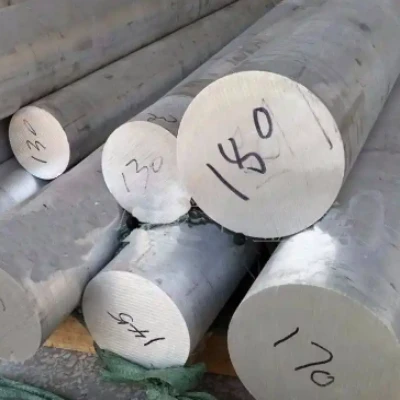
Extrusion Steps
Aluminum bar laid flat → Heating → Reaching 480°C and holding for 1 hour → Mold heated to 480°C → Mold placed in die holder → Transferred to the billet inlet → Extrusion → Pulling → Straightening → Aging → Unloading from the furnace → Reaching 200°C and holding for 2 hours → Cooling → Completed
1. Ingot Preparation: Select the appropriate aluminum alloy ingot based on the required performance of the round bar. For example, 6063 aluminum alloy is used for general building profiles, while 7075 aluminum alloy is used for high-strength structural parts. Saw the ingot to the desired length within a tolerance of ±2mm. Mechanical or chemical methods remove surface scale and inclusions to a roughness of Ra3.2 to Ra6.4μm.
2. Billet Heating: Place the ingot in the heating furnace and control the heating rate at 5-10°C/min to prevent excessive thermal stress that could cause cracking. Heat to the appropriate temperature and hold for a specified period of time to achieve uniform temperature inside and outside the ingot. The holding time is calculated as 1 to 1.5 hours per 50mm of ingot diameter.
3. Mold Preparation: Select a mold that matches the size and performance requirements of the round bar. Check the mold surface hardness and roughness. The hardness should reach HRC 58-62, and the roughness should be Ra 0.8-Ra 1.6μm. Preheat the mold before use at 400-450°C for 1-2 hours.
4. Mold Installation and Loading: Install the preheated mold on the extruder and secure it with specialized tools, ensuring concentricity between the mold and the extrusion barrel within ±0.1mm. Place the heated billet into the extrusion barrel, maintaining a clearance of 0.5-1mm between the billet and the barrel wall.
5. Extrusion Operation: Start the extruder. The extruder rod pushes the billet at the set speed and pressure, forcing the billet through the die hole into a round bar. During the extrusion process, the extrusion speed and pressure are maintained stable, with fluctuations within ±5%.
6. Discharging and Cooling: The extruded round bars are discharged through a discharging device and cooled using air, water, or mist cooling. The air cooling speed is 5-10 m/s, the water cooling temperature is controlled at 20-30°C, and the atomized particles produced by mist cooling are 5-10 μm in diameter.
7. Stretching and Straightening: The round bars are stretched and straightened using a stretching machine, with the stretching controlled at 0.5%-1.5%. After straightening, the straightness of the round bars is within 0.5 mm/m.
8. Dimension Inspection and Surface Treatment: The dimensions of the round bars are inspected using calipers and micrometers. The diameter tolerance is controlled within ±0.1 mm, and the form and position tolerances, such as straightness, meet relevant standards. Surface treatments such as anodizing and painting are performed as required.
Process Control Parameters
1. Temperature: The billet heating temperature varies for different aluminum alloys. For example, the billet heating temperature for 6063 aluminum alloy is 460-490°C, and the billet heating temperature for 7075 aluminum alloy is 420-450°C. The die temperature is generally 10-30°C lower than the billet temperature.
2. Extrusion Speed: The extrusion speed for 6063 aluminum alloy is 5-15 m/min, and for 7075 aluminum alloy is 1-5 m/min. For round bars with complex shapes or large diameters, a lower speed is recommended.
Extrusion Ratio: The extrusion ratio for general aluminum alloy round bars is 8-25. For high-performance round bars, the extrusion ratio can be 25-50.
3. Pressure: The extrusion pressure for 6063 aluminum alloy is 60-100 MPa, and for 7075 aluminum alloy is 80-150 MPa.
4. Lubrication: Apply glass lubricant at 450-550°C, with a thickness of 0.2-0.5mm. Control the concentration of graphite lubricant to 10%-20%, with a coating amount of 5-10g/m².
This concludes the pressurization process for aluminum alloy round bars. I hope this helps.
Send Inquiry