

4 Key Differences Between 201 and 202 Stainless Steel Pipes!
Aug 06, 2025
Leave a message
201 and 202 stainless steel pipes are two common stainless steel materials in our daily lives, and they are widely used in many areas. However, although both belong to the stainless steel family, there are certain differences in composition, performance, and applications. This article will detail the differences between these two types of stainless steel pipes to help you better understand their performance characteristics and application ranges.
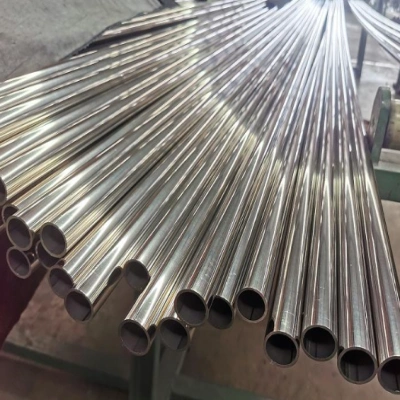
What is the difference between 201 and 202 stainless steel pipes?
1. From a compositional perspective, the main difference between 201 and 202 stainless steel pipes lies in their nickel content. 201 stainless steel pipes have a lower nickel content, generally between 3.5% and 5.5%, while 202 stainless steel pipes have a higher nickel content, generally between 8% and 10%. Nickel is a key alloying element that significantly improves the corrosion resistance of stainless steel. Therefore, 202 stainless steel pipes have superior corrosion resistance to 201 stainless steel pipes.
2. From a performance perspective, the difference in nickel content between 201 and 202 stainless steel pipes also leads to differences in performance. 201 stainless steel pipe has good plasticity but lower strength, making it easier to process and shape. 202 stainless steel pipe, on the other hand, has high strength and good wear resistance, but poor plasticity and is more difficult to process. Furthermore, 201 stainless steel pipe has strong magnetism, while 202 stainless steel pipe has weaker magnetism. These differences in properties give them advantages in different applications.
3. The application scopes of 201 and 202 stainless steel pipes also differ. Due to its lower cost and good plasticity, 201 stainless steel pipe is often used in the manufacture of decorative products such as doors, windows, and guardrails. 201 stainless steel pipe can also be used to manufacture mechanical parts that do not require high corrosion resistance. 202 stainless steel pipe, on the other hand, is widely used in the manufacture of industrial equipment, chemical equipment, and food processing equipment due to its higher strength and wear resistance. In these applications, 202 stainless steel pipe can withstand higher pressures and temperatures, ensuring the normal operation of the equipment.
4. In addition to the aforementioned differences in composition, performance, and application, there is also a certain price difference between 201 and 202 stainless steel pipes. Generally speaking, due to the high nickel content, 202 stainless steel pipe is relatively expensive, while 201 stainless steel pipe is relatively cheaper. Therefore, when choosing stainless steel pipe, users need to consider their needs and budget.
As two common stainless steel materials, 201 and 202 stainless steel pipes differ in composition, performance, and application. Understanding these differences can help us better select the appropriate stainless steel pipe material to meet the needs of different applications. In actual use, it is also important to select stainless steel pipes of qualified quality produced by reputable manufacturers to ensure stable and reliable performance. We hope this article provides some useful reference value.
Mob: +86-13772502581
Email: Judesteel@Juqing.Hk
Send Inquiry